


Technical Courses: Basic Lean Six Sigma Application
About Course
This training is designed to equip participants with the knowledge and skills necessary to lead process improvement initiatives using Lean Six Sigma methodologies.
Course Overview
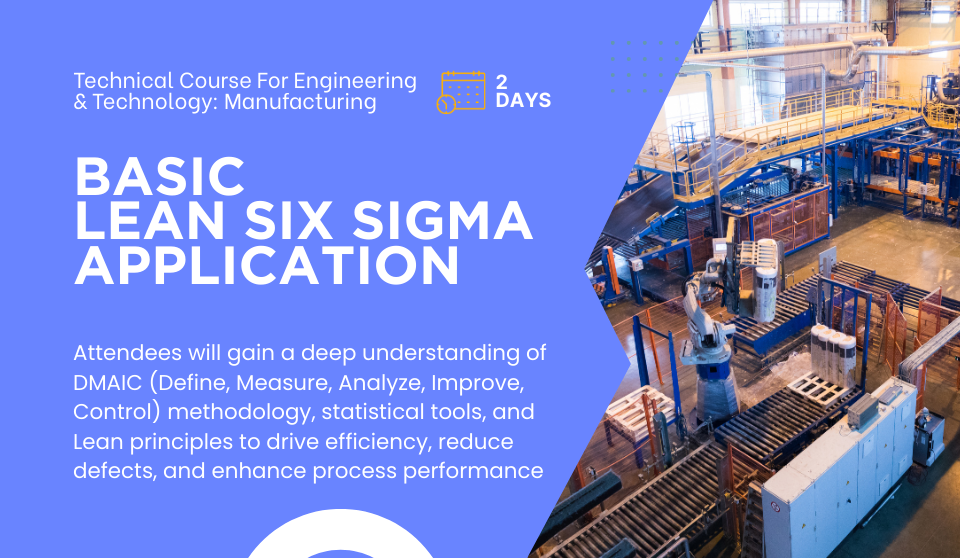
This training is designed to equip participants with the knowledge and skills necessary to lead process improvement initiatives using Lean Six Sigma methodologies. Attendees will gain a deep understanding of DMAIC (Define, Measure, Analyze, Improve, Control) methodology, statistical tools, and Lean principles to drive efficiency, reduce defects, and enhance process performance. Additionally, participants will learn how to successfully initiate, execute, and manage a Green Belt project, applying Lean Six Sigma tools to solve real-world business problems and deliver measurable improvements.
Course Objective
- To develop problem-solving and process improvement skills using the DMAIC framework to identify, analyze, and eliminate inefficiencies and defects.
- To foster a culture of continuous improvement by promoting waste reduction, variation control, and enhanced customer satisfaction.
- To enable data-driven decision making through the application of statistical tools and techniques that ensure measurable and sustainable improvements.
Course Outline
Day 1
MODULE 1 : Introduction To Lean Six Sigma
- Overview of Lean and Six Sigma
- Benefits and business impact
- Roles and responsibilities in a Six Sigma project
MODULE 2 : Define Phase
- Problem identification and green belt project charter.
- Voice of Customer (VOC) and Critical to Quality (CTQ) factors
- SIPOC (Suppliers, Inputs, Process, Outputs, Customers) analysis
MODULE 3 : Measure phase
- Data collection and measurement system analysis
- Process mapping and baseline performance assessment
Day 2
MODULE 4 : Analyze Phase
- Root cause analysis (Fishbone, 5 Whys, Pareto Analysis)
- Hypothesis testing and statistical analysis
- Identifying sources of variation and process inefficiencies
MODULE 5 : Improve Phase
- Lean tools for waste elimination (Kaizen, 5S, Value Stream Mapping)
- Solution identification and pilot testing
- Design of Experiments (DOE) and implementation strategies
MODULE 6 : Control Phase
- Standardization and control charts
- Risk management and mistake-proofing (Poka-Yoke)
- Sustaining improvements through monitoring and audits
Who Should Join?
General practioners

Reviews
There are no reviews yet.